Rely on many small incomes to replace the one or two large ones.
Six income Levels in Retirement
Retirement wealth is categorized into six tiers, ranging from financially vulnerable seniors with under $69,500 to the ultra-wealthy with over $11 million in net worth. The six tiers are:
- Financially Vulnerable / At-Risk (27% of retirement households)
- Net Worth: $69,500 or less.
- Social Security is the whole paycheck.
- $25K - $38.5 (if married) household income.
- Characteristics: This bottom 27% of retirees relies heavily on Social Security and Medicare. They are highly susceptible to financial shocks and may struggle to meet basic needs which typically include rent, food and prescription drugs. Every dollar that comes in is already accounted for before it’s ever spent. Home repair and items that Medicare doesn’t cover (e.g., dental work and hearing aids) may get put off for years. They often rely on safety nets such as SNAP.
- Lower Middle Class / Working Class (18%)
- Net Worth: $69,500 to $394,300.
- Social Security plus a cushion (IRA and/or 401k).
- $40K – $60K household income.
- Characteristics: Retirees in this tier have modest assets and can cover basic expenses but cannot afford a luxurious retirement. Withdrawals from IRAs or 401k's aren’t planned. They’re usually reactions to cover unplanned expenses such as medical bills or house and car repairs. They take one modest trip a year, often to see family. Many chose a Medicare advantage plan.
- Solidly Middle Class (16%)
- Net Worth: $394,300 to $1.16 million.
- All expenses are covered by guaranteed income.
- $50K – $75K household income.
- Characteristics: This is the center group of American retirement. They enjoy a comfortable retirement with access to discretionary spending. Social Security plus a pension or annuity pays the day-to-day bills. Their portfolio pays for the extras. However, converting non-liquid assets like property into cash may be necessary, and disciplined spending is important to ensure long-term financial security.
- Upper Middle Class (17%)
- Net Worth: $1.2 million to $2.9 million.
- They have 3 or more income streams (e.g., social security, pension or annuity, and planned portfolio withdrawals.)
- $75K – $120K household income.
- Characteristics: Retirees here have a strong foundation for a comfortable lifestyle, including travel and healthcare flexibility. They can handle unexpected expenses but should continue prudent financial management. Level 4 retirees are typically engineers, managers, nurses and dual earners who put money into 401k’s for 30 or more years.
- Wealthy / Affluent (13%)
- Net Worth: $2.9 million to $11 million.
- Here the problem flips to taxes. How to avoid extra unneeded income such as required minimum retirement account distributions (RMDs) which trigger extra taxes.
- $120K - $200K household income.
- Characteristics: This tier allows for a luxurious retirement with significant financial freedom. Retirees can enjoy extensive travel, high-quality healthcare, and legacy planning. Strategic investment and estate planning remain important. Level 5 retirees typically pay a surcharge (IRMAA) on their Medicare part B premium.
- Ultra-Wealthy / Top 1%
- Net Worth: Over $11 million.
- The investment account principal stays put. It is not spent down. Dividends, interest, rental income, and business distributions cover their entire lifestyle. Social security is less important.
- $200k or more household income that lasts indefinitely.
- Characteristics: The top tier represents the wealthiest retirees, often with diversified investments, multiple properties, and substantial financial influence. They have the highest level of security and flexibility, with opportunities for philanthropy and intergenerational wealth transfer. Level 6 people are typically retired business owners, executives, physicians, partners, and many still sit on boards or advise companies.
Summary
These six tiers provide a framework to understand retirement readiness and financial security. They highlight the importance of early savings, investment planning, and risk management to move up the tiers and achieve a more comfortable or secure retirement lifestyle. Recognizing your tier can guide decisions on budgeting, asset allocation, and retirement timing.
Retirement Income Overview

Pre-retirement income typically originates from one main source (your employer). You may have other income such as dividends, interest, capital gains and rental income, but these are usually dwarfed by your employment income. Retirement income is usually quite different in that it is made up of several, or oftentimes many, individual sources. For example you may receive a social Security check as well as a pension check and an annuity check. Your spouse may receive a social security check as well as others. Each source may be significantly smaller than your employer’s check, but hopefully together the group of individual checks constitutes a significant portion (50-80%) of your pre-retirement income.
Another interesting phenomenon with retirement income is that while you are working your employer sets your salary; however, once you retire, you decide how much salary that you’re going to receive. You will need to withdraw each month at least enough to meet your budget requirements. Money can be withdrawn from a tax-deferred account without penalty once you reach the age of 59 ½, and a portion of it must be withdrawn annually once you reach the age of 73. The amount that you withdraw will determine how long your savings will last and the amount of income taxes that you pay during the current year.
Where possible you should time your withdrawals so as to minimize your taxes. For example, if you receive any extraordinary income in a given year (e.g., deferred salary, stock exercise income, a large capital gain), then you should try to minimize your other income (e.g., withdrawals) during that year. If you can avoid it, you don’t want a spike in income that could bump you into a higher tax bracket. As a simple rule “prior to retirement focus on income and after retirement focus on taxes”.
There are fundamentally seven, and only seven, sources of retirement income – pension, social security, dividends, interest, annuity payments, investment fund payouts/withdrawals, and rent and royalty income. The following web pages provide a description of each and suggest way of using them together to rightsize your income.
In the adjacent column of this page is an example of how the various forms of retirement income can work together to provide you with the lifestyle you desire. Notice that I didn't say "what you deserve" because I believe that we only deserve what we plan for and build. This section should assist you in building an investment and income portfolio that will help ensure "the best retirement of a lifetime".
Keep in mind that the pie chart example is based on hypothetical data. Your pie chart will probably differ substantially based on where you put your investment dollars in per-retirement years.
Various Sources of Retirement Income
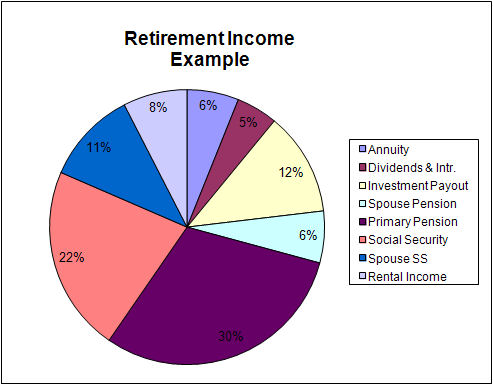
This pie chart demonstrates various possible sources of a retiree's income. Although its sections are not applicable to all retirees, it serves to demonstrate the concept of "replacing one large monthly income by many smaller incomes." Each "slice" of this pie chart is addressed in the various webpages covering the "Income" topic.